.png)

Group Reflection
Updated: Apr 29
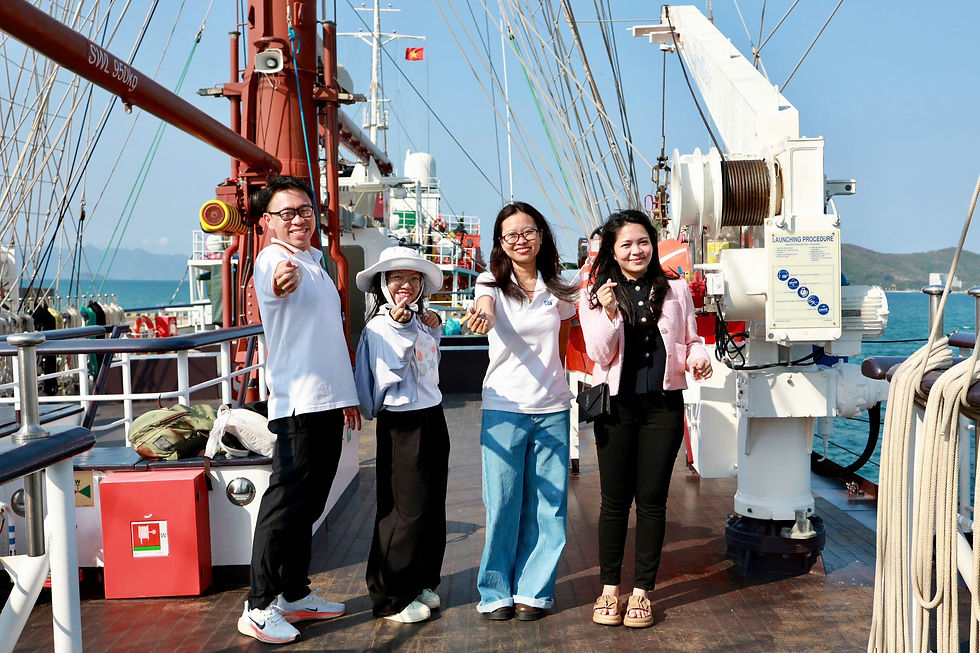
Throughout our practicum at the Naval Academy, we developed a deeper understanding of what effective teamwork truly requires in a professional academic setting. Our group is grateful for the opportunity to come to a new academic setting and the ability to work together collaboratively. One of the clearest lessons we learned was that successful collaboration depends not only on goodwill, but also on careful organization, shared responsibility, and mutual trust. From the early preparation stage, we divided tasks according to each member’s strengths and assigned clear responsibilities for different aspects of the practicum, such as contacting lecturers regarding class observations and micro-teaching sessions, preparing materials, designing slides, rehearsing presentations, and handling logistical details. This systematic distribution of work enabled us to avoid unnecessary pressure on any single member and helped the group function in a more coordinated and efficient manner. More importantly, it taught us that teamwork is most productive when every member understands both their individual role and the collective goal.
Another valuable lesson we gained was the importance of adaptability. The teaching and learning context at the Naval Academy differed from more familiar classroom settings in several ways, especially in terms of the limited use of technology. Since cadets and teachers were not allowed to use phones or personal electronic devices during classes, we had to rethink some of our initial assumptions about technology-assisted language learning. Rather than depending heavily on digital tools, we learned to adjust our activities into non-digital instructional materials so that they would still be interactive, practical, and engaging within the constraints of the local context. This experience reminded us that good teaching is not about applying methods mechanically, but about adapting pedagogy to the realities of learners, institutions, and available resources. This shift in perspective challenged us to prioritize human centricity, reinforcing the idea that the teacher’s presence and instructional clarity are the most important tools in any classroom. In this sense, the practicum helped us become more flexible and context-sensitive as future TESOL professionals.
Working together as a group also strengthened a range of professional skills that are essential not only in education but in any collaborative workplace. We learned how to support one another more effectively, how to manage time more carefully, and how to remain responsible for our own tasks while still being attentive to the needs of the team. Rehearsing together, giving peer feedback, revising materials, and solving small problems as they arose all contributed to our growth in collaborative skills. Even when there were differences in opinions or working styles, we gradually learned to listen more carefully, negotiate more respectfully, and prioritize the overall quality of the group’s work over individual preferences. This experience helped us realize that teamwork is not the absence of difference, but the ability to move forward constructively despite it.
Beyond these professional gains, the practicum also changed some of our perceptions. Before the trip, some of us may have assumed that the military environment would feel distant, rigid, or difficult to connect with. However, our interactions with the students and teachers at the Naval Academy challenged those assumptions. Although they were highly disciplined and serious in their routines, they were also extremely welcoming, sincere, and friendly. Their warmth and openness broke many of our stereotypes and made us reflect more carefully on the importance of approaching unfamiliar educational contexts without prejudice. This realization was meaningful because it reminded us that professionalism and friendliness can coexist, and that educational environments often reveal much more depth once we engage with them directly. Moreover, this experience also highlights the value of cultural humility, reminding us to approach any new community with an open mind and the willingness to learn from our students as much as we teach them.
The practicum also left a strong emotional and personal impression on us. Visiting the Naval Academy and learning more about its traditions and values awakened in us a deeper sense of patriotism, national pride, and respect for those who serve the country. As a group, we did not experience this practice only as a teaching-related assignment, but also as an opportunity to connect more deeply with our national context and with the human values embedded in education. These experiences broadened our perspective and made the practicum more meaningful than a purely academic exercise.
In conclusion, our practicum was a highly formative group experience that enriched us both professionally and personally. It strengthened our sense of teamwork, responsibility, flexibility, time management, and mutual support, while also teaching us to adapt to a specific institutional context with greater sensitivity and professionalism. At the same time, it challenged our assumptions, deepened our appreciation of the Naval Academy community, and inspired a stronger sense of patriotism and national pride. We are truly grateful for this opportunity, as it not only helped us grow as a team, but also shaped our development as more reflective, adaptable, and collaborative future TESOL educators.


Comments